Bilingual Class 5 EVS Chapter 12 Notes Elements, Compounds And Mixtures| KSEEB Solutions | www.notes.studymanzil.com
Bilingual Class 5 EVS Chapter 12 Notes Elements, Compounds And Mixtures
Notes By : SYED RASOOL
Bilingual Class 5 EVS Chapter 12 Notes Elements, Compounds And Mixtures| KSEEB Solutions
KSEEB Solutions for Bilingual Class 5 EVS Chapter 12 Elements, Compounds And Mixtures is provided below to help Class 5 students understand the lesson more effectively. The KSEEB Solutions for Class 5 EVS are prepared by subject teachers according to the new KSEEB Class 5 EVS syllabus in Bilingual English and Urdu.
Tags: 5th EVS Chapter 12 question Answer, 5th EVS Notes, 5th EVS Notes Elements, Compounds And Mixtures question answer, Bilingual class 5 EVS notes,5th EVS question answer chapter Elements, Compounds And Mixtures , KSEEB solutions class 5 EVS, Elements, Compounds And Mixtures notes, Elements, Compounds And Mixtures question answer class 5, fifth Enviornmental Science question answers, Notes Class5 EVS Lesson Elements, Compounds And Mixtures.
Get comprehensive bilingual English and Urdu revision notes along with complete page-by-page textbook solutions for Class 5 Environmental Studies (EVS) Chapter 12: Elements, Compounds And Mixtures under the Karnataka State Syllabus.
Bilingual Class 5 EVS Chapter 12 Notes Elements, Compounds And Mixtures| KSEEB Solutions | www.notes.studymanzil.com
The Class 5 EVS Bilingual, KSEEB Solutions For Class 5 EVS Lesson Elements, Compounds And Mixtures offered here serves as a comprehensive guide to grasp essential topics thoroughly. Crafted to facilitate a deep understanding of the lessons, these solutions are tailored to enhance comprehension. By utilizing these resolved KSEEB Solutions for Class 5 EVS Bilingual English Urdu Medium, students can not only achieve commendable marks but also reinforce their retention of the subject matter over an extended period. Explore these user-friendly solutions to excel in Class 5 EVS studies.
Notes Class 5 EVS Lesson Elements, Compounds And Mixtures
Table of Contents
Video Lesson Class 5 EVS Bilingual Chapter 12: Elements, Compounds And Mixtures | in English Urdu | پنجم جماعت ماحولیاتی مطالعہ
اس طرح کے مزید نوٹس اور درسی وسائل کی تیاری میں ہماری حوصلہ افزائی کے لئے ہمارے یوٹیوب چینل اسٹڈی منزل اور تعلیمی منزل کو سبسکرائب کریں۔ لنک نیچے دئے گئے ہیں۔


Part 1: Quick Revision Notes
Lesson 12: Elements, Compounds And Mixtures – Essence of Life (Short Notes for Class 5)
1. Introduction to Matter & Atoms
- Constituents of Matter: Matter available in nature consists of molecules or compound molecules. Subdividing these gives elements.
- Atom: The smallest unit of an element is called an atom. It is the smallest unit of an element that retains all its properties.
- Classification: Based on the atoms present, substances are classified into Elements, Compounds, and Mixtures.
2. Elements
- Definition: Elements are made up of very small particles that possess the exact same properties.
- Characteristics: Elements cannot be subdivided chemically and cannot be synthesized from other elements.
- Sources: Some elements occur naturally (e.g., Gold), while others are artificially prepared in laboratories (e.g., Plutonium). Elements are broadly classified into metals and non-metals.
- States of Matter Examples:
- Solid: Iron, Mercury (Liquid metal at room temperature)
- Liquid: Mercury
3. Compounds
- Definition: Formed when two or more elements combine chemically in a specific fixed ratio to form a substance with entirely new properties.
- Molecular Formula: Represented using chemical symbols to show the exact number of atoms of each element in a molecule.
- Properties: A compound does not possess the individual properties of its constituent elements.
- Example 1: Water (
 ) is a compound formed by Hydrogen and Oxygen in a
 ratio.
- Example 2: Sodium Chloride (Common Salt) is made of Sodium and Chlorine. While both individual elements are poisonous, the compound formed by them is safe and edible.
- Example 1: Water (
- Separation: The constituents of a compound cannot be separated by simple physical methods.
- States of Matter Examples: Sugar (Solid), Water (Liquid), Carbon Dioxide at room temperature (Gas).
4. Mixtures
- Definition: Formed when two or more substances (elements or compounds) are mixed together in any proportion/ratio without undergoing any chemical change.
- Properties: The individual components of a mixture retain their original properties.
- Example: Soil is a mixture of sand, clay, various salts, and plant/animal residues.
- Separation: The constituents of a mixture can easily be separated by simple physical methods.
- States of Matter Examples: Soil (Solid), Sea Water (Liquid), Air (Gas mixture).
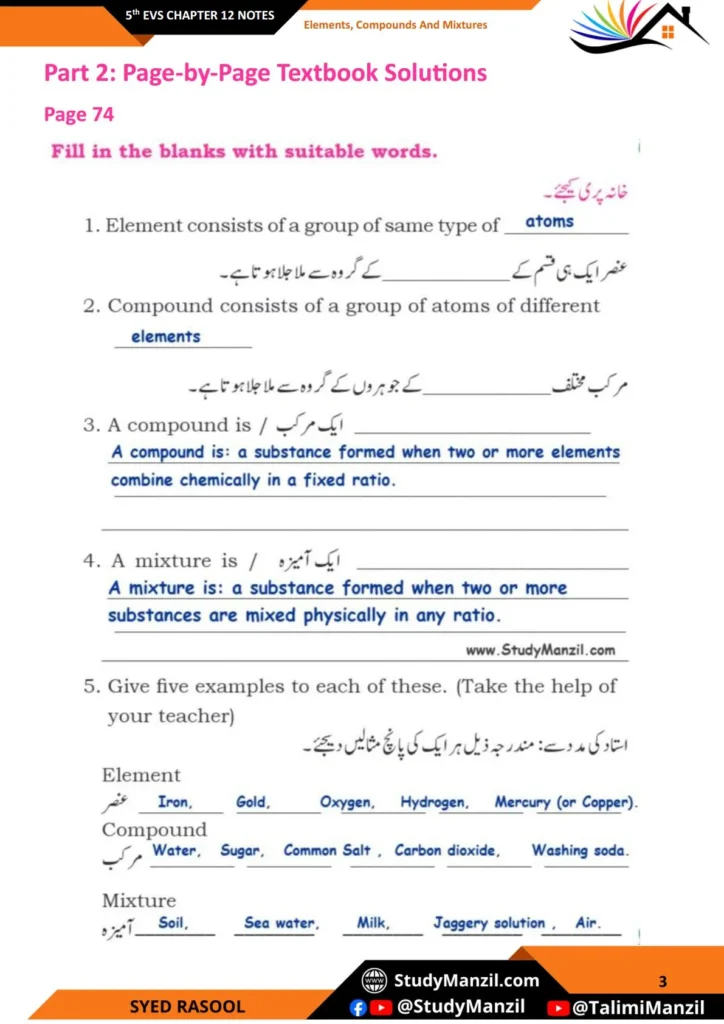
Part 2: Page-by-Page Textbook Solutions
PAGE – 74