Bilingual Class 5 EVS Chapter 11 Notes Nature of Matter | KSEEB Solutions | www.notes.studymanzil.com
Bilingual Class 5 EVS Chapter 11 Notes Nature of Matter
Notes By : SYED RASOOL
Bilingual Class 5 EVS Chapter 11 Notes Nature of Matter | KSEEB Solutions
KSEEB Solutions for Bilingual Class 5 EVS Chapter 11 Nature of Matter is provided below to help Class 5 students understand the lesson more effectively. The KSEEB Solutions for Class 5 EVS are prepared by subject teachers according to the new KSEEB Class 5 EVS syllabus in Bilingual English and Urdu.
Tags: 5th EVS Chapter 11 question Answer, 5th EVS Notes, 5th EVS Notes Nature of Matter question answer, Bilingual class 5 EVS notes,5th EVS question answer chapter Nature of Matter , KSEEB solutions class 5 EVS, Nature of Matter notes, Nature of Matter question answer class 5, fifth Enviornmental Science question answers, Notes Class5 EVS Lesson Nature of Matter.
Get comprehensive bilingual English and Urdu revision notes along with complete page-by-page textbook solutions for Class 5 Environmental Studies (EVS) Chapter 11: Nature of Matter under the Karnataka State Syllabus.
Bilingual Class 5 EVS Chapter 11 Notes Nature of Matter | KSEEB Solutions | www.notes.studymanzil.com
The Class 5 EVS Bilingual, KSEEB Solutions For Class 5 EVS Lesson Nature of Matter offered here serves as a comprehensive guide to grasp essential topics thoroughly. Crafted to facilitate a deep understanding of the lessons, these solutions are tailored to enhance comprehension. By utilizing these resolved KSEEB Solutions for Class 5 EVS Bilingual English Urdu Medium, students can not only achieve commendable marks but also reinforce their retention of the subject matter over an extended period. Explore these user-friendly solutions to excel in Class 5 EVS studies.
Notes Class 5 EVS Lesson Nature of Matter
Table of Contents
Video Lesson Class 5 EVS Bilingual Chapter 9: Food | in English Urdu | پنجم جماعت ماحولیاتی مطالعہ
اس طرح کے مزید نوٹس اور درسی وسائل کی تیاری میں ہماری حوصلہ افزائی کے لئے ہمارے یوٹیوب چینل اسٹڈی منزل اور تعلیمی منزل کو سبسکرائب کریں۔ لنک نیچے دئے گئے ہیں۔


Part 1: Quick Revision Notes
Lesson 11: Nature of Matter (Short Notes for Class 5)
1. What is Matter?
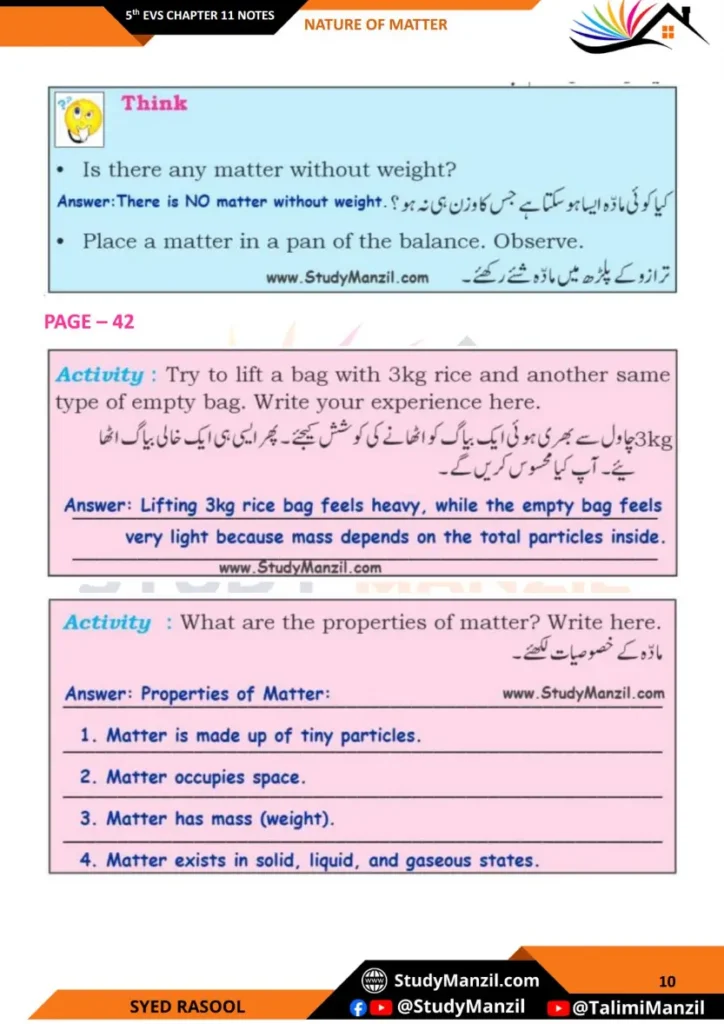
- Definition: Scientifically, any material or object in our surroundings that occupies space and possesses mass (weight) is called Matter.
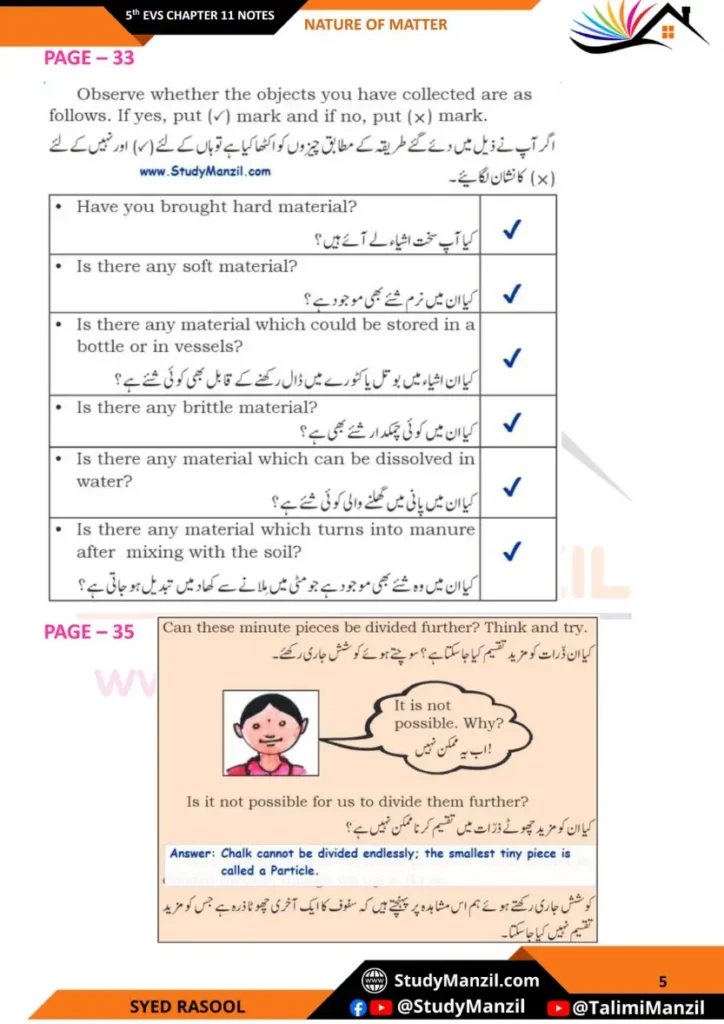
- Particle Nature: Matter is made up of extremely tiny, invisible particles. The smallest piece of matter is called a particle.
- Key Properties of Matter:
- Matter occupies space (one matter cannot occupy the place of another at the same time).
- Matter has mass (weight depends on the total number of particles it contains).
2. Three States of Matter
Depending on how particles are arranged, matter exists in three physical states:
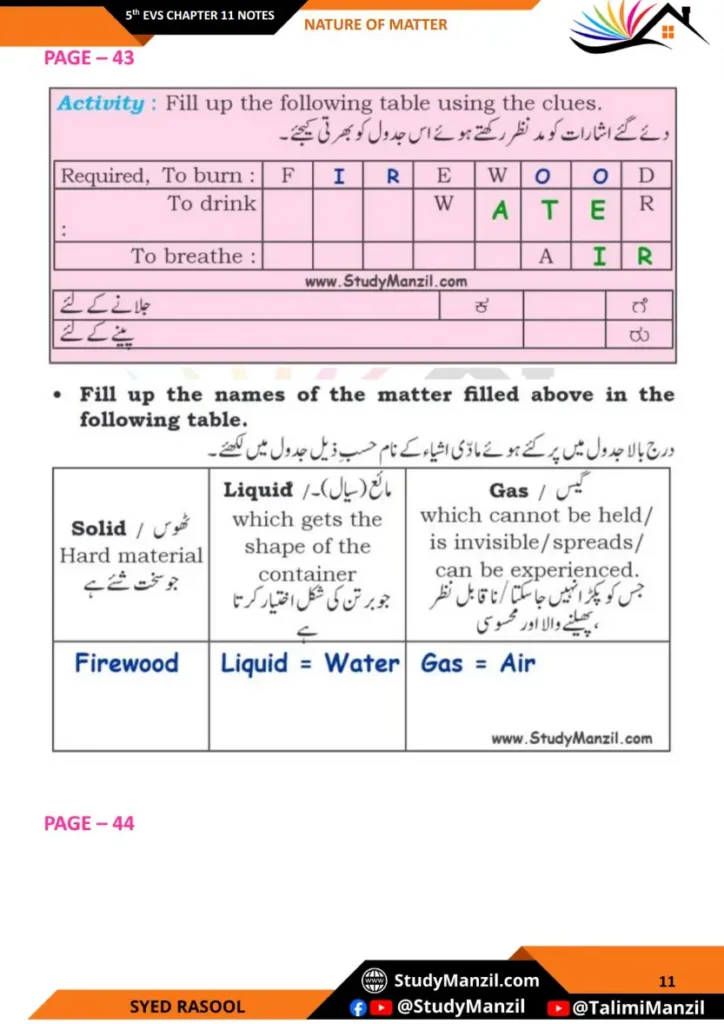
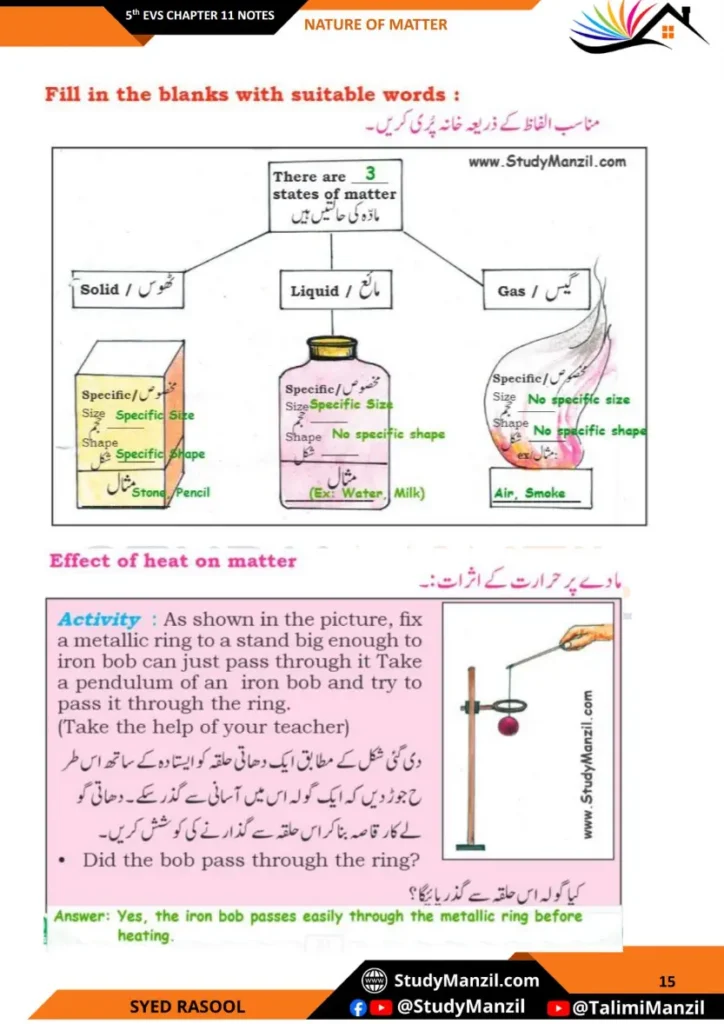
- Solids: Particles are densely and orderly packed. They have a fixed shape and size that does not easily change (e.g., stone, iron, pencil).
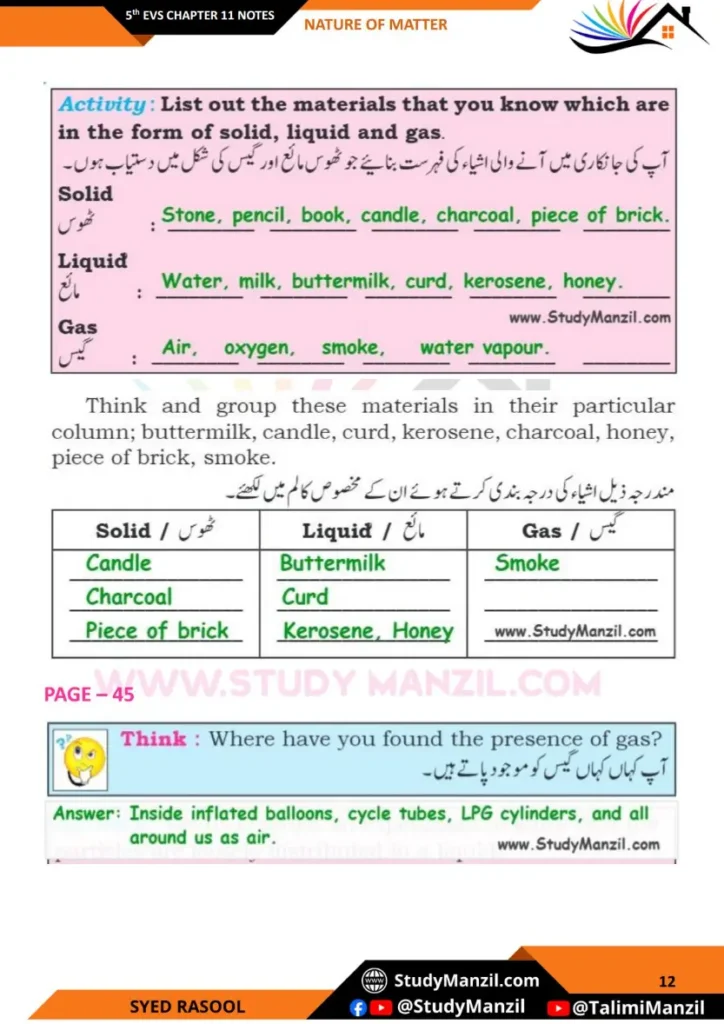
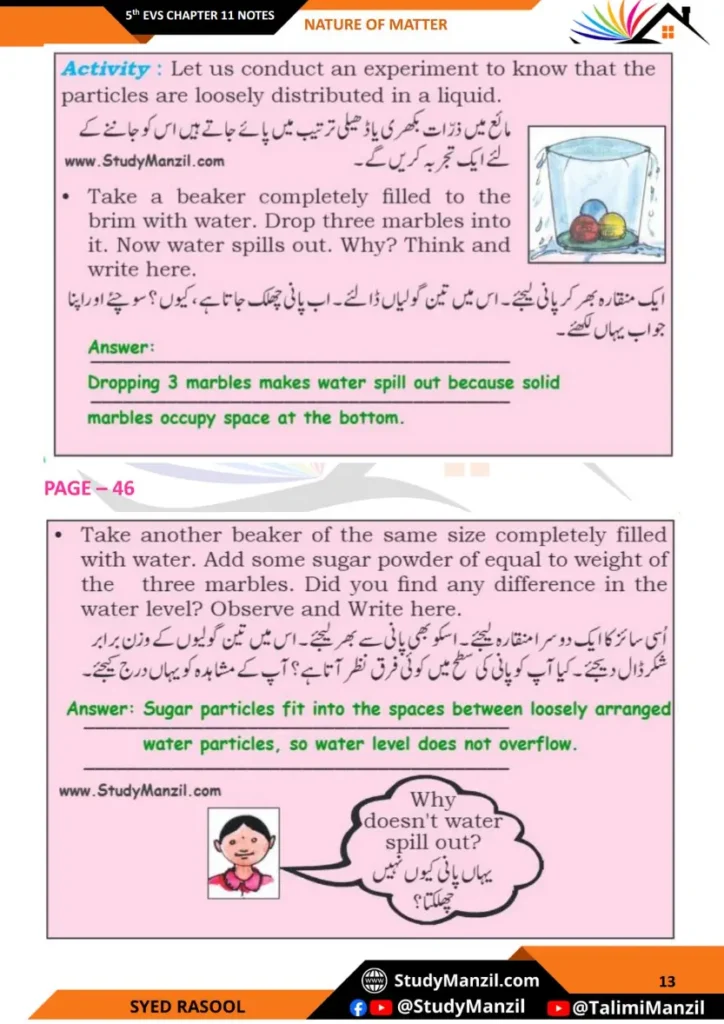
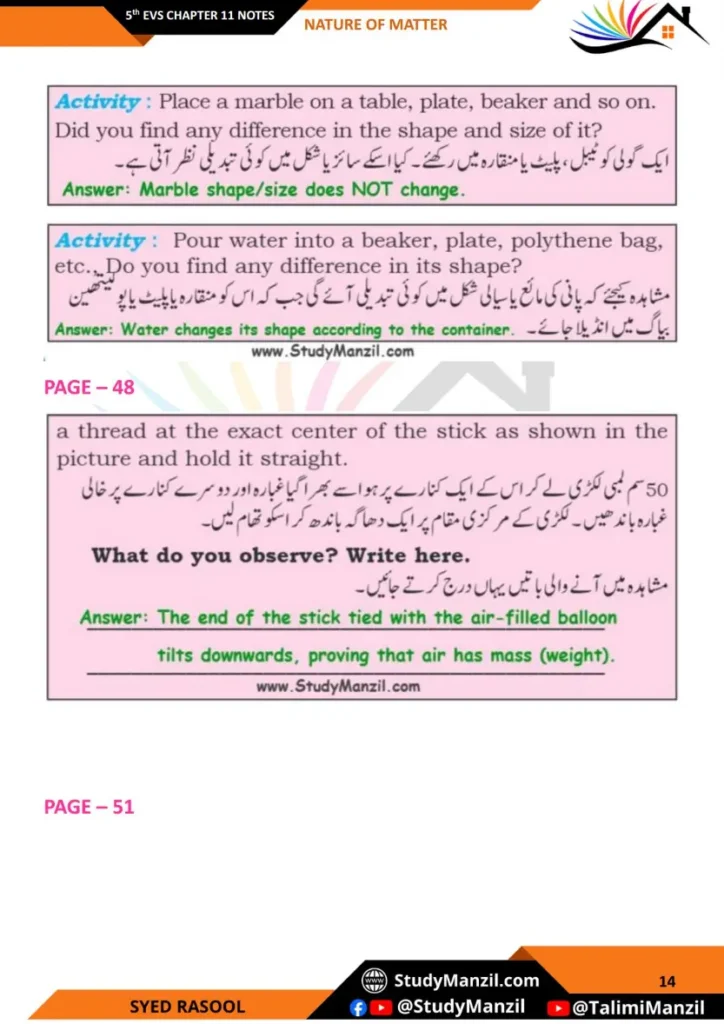
- Liquids: Particles are loosely arranged compared to solids. They have a fixed volume but take the shape of the container they are poured into (e.g., water, milk, oil).
- Gases: Particles are sparsely (widely) arranged. They have no fixed shape or volume and spread out to fill the entire container (e.g., air, smoke).
3. Effects of Heat on Matter
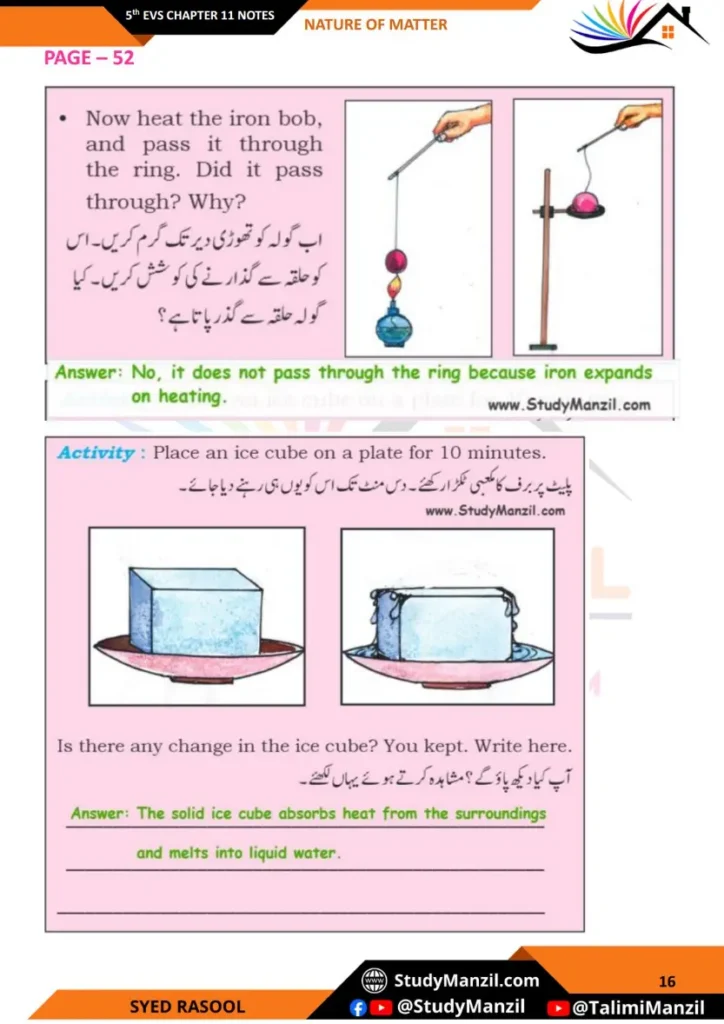
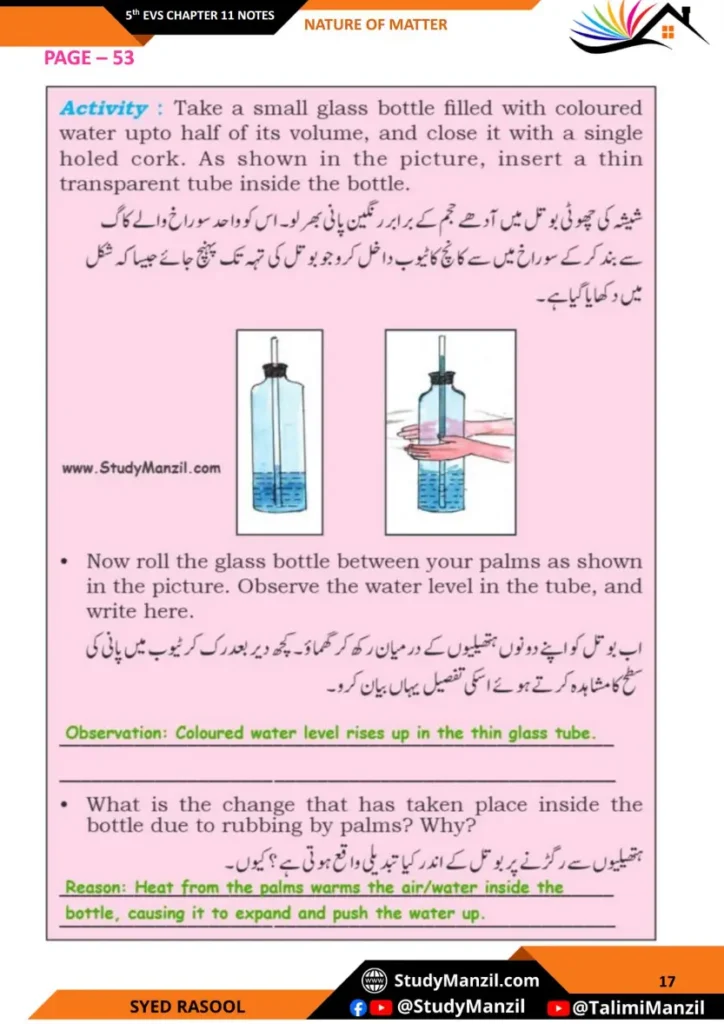
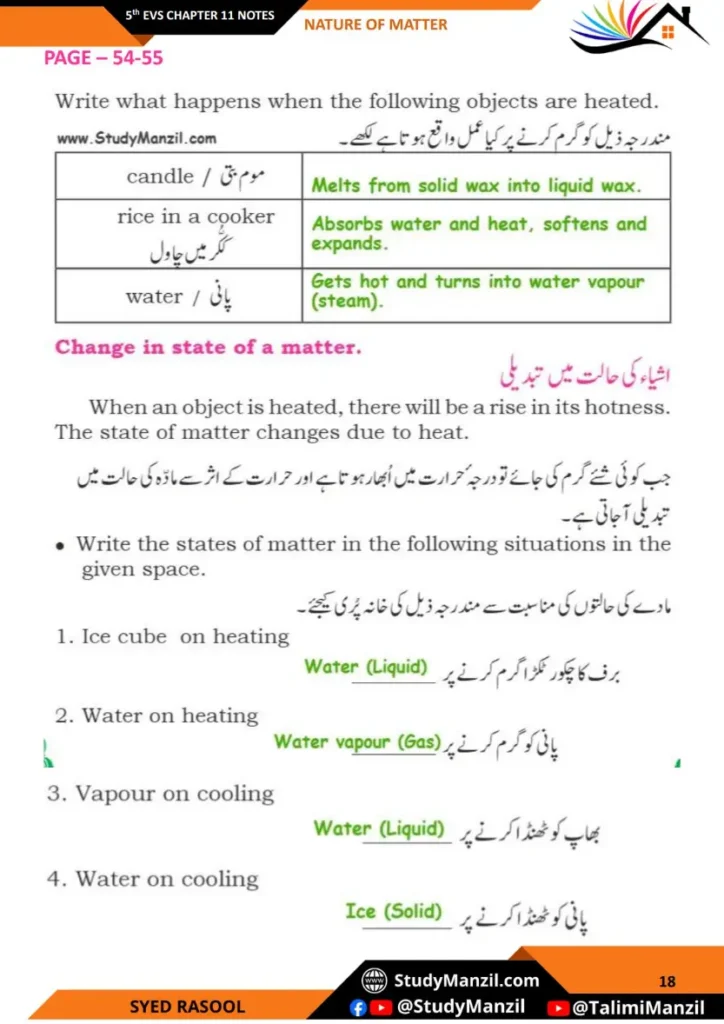
- Expansion: Matter expands (gets larger/takes up more space) when heated. Solids, liquids, and gases all expand upon heating.
- Change of State: Adding or removing heat changes matter from one state to another:
- Solid
 Liquid (on heating, e.g., ice melting into water)
- Liquid Gas (on heating, e.g., water turning into vapour)
- Gas Liquid (on cooling, e.g., vapour condensing)
- Liquid Solid (on cooling, e.g., water freezing into ice)
- Solid
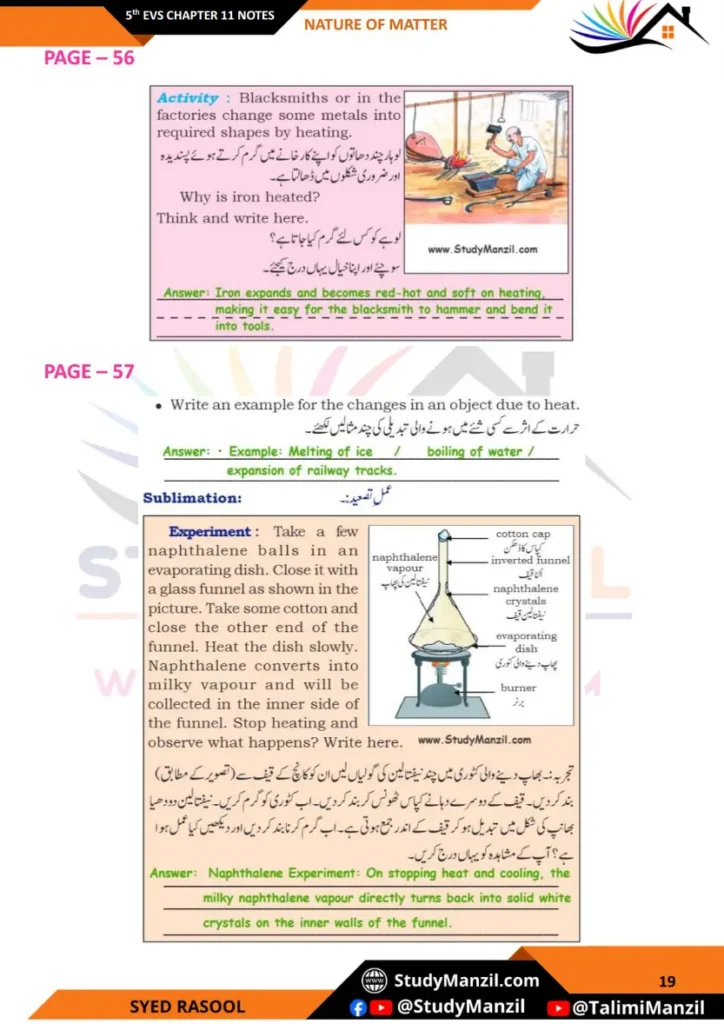
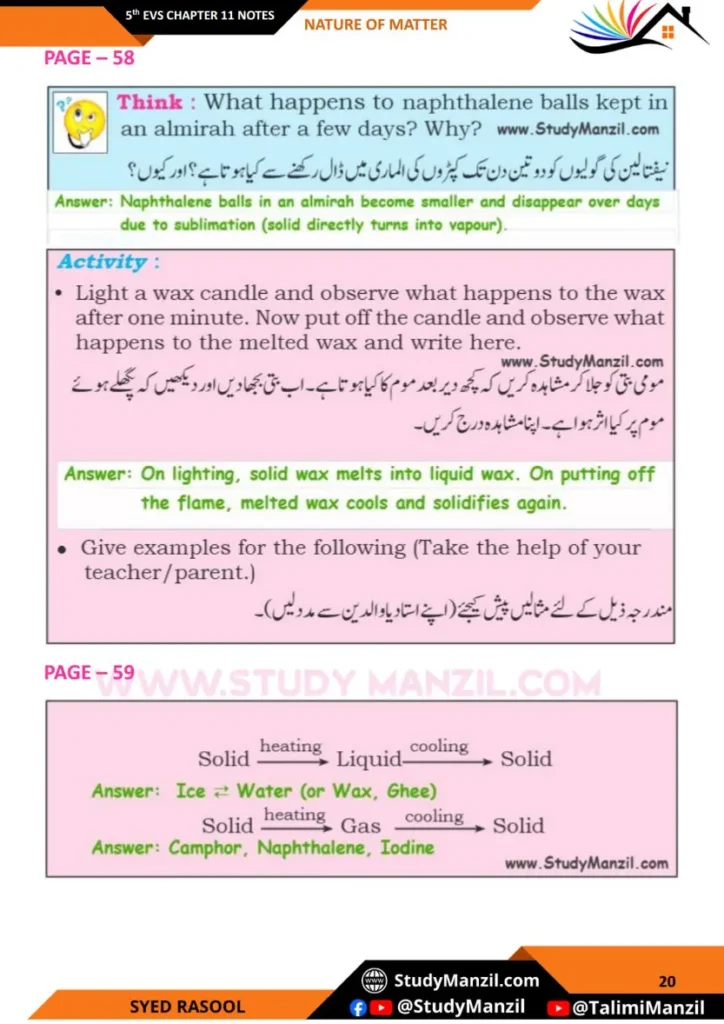
- Sublimation: Some solids convert directly into vapour on heating without passing through the liquid state (and vice versa on cooling). Examples: Camphor, iodine, naphthalene.
4. Physical Quantities & Concepts
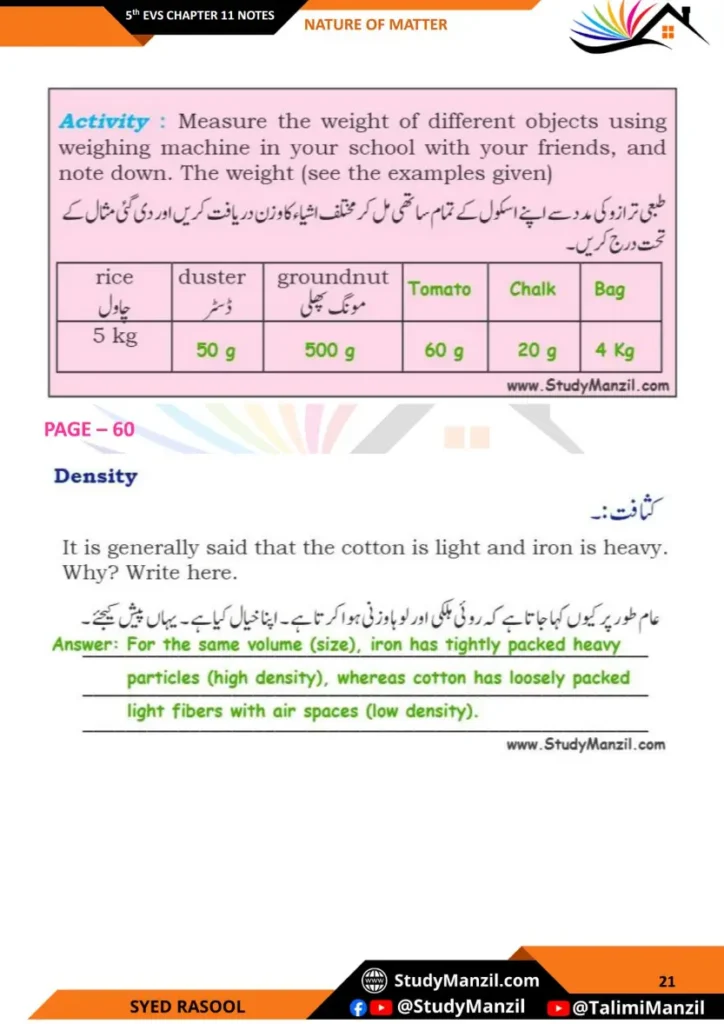
Mass: The total quantity of matter in an object. Measured in milligrams (mg), grams (g), kilograms (kg), quintals, and tons. SI unit is kilogram (kg).
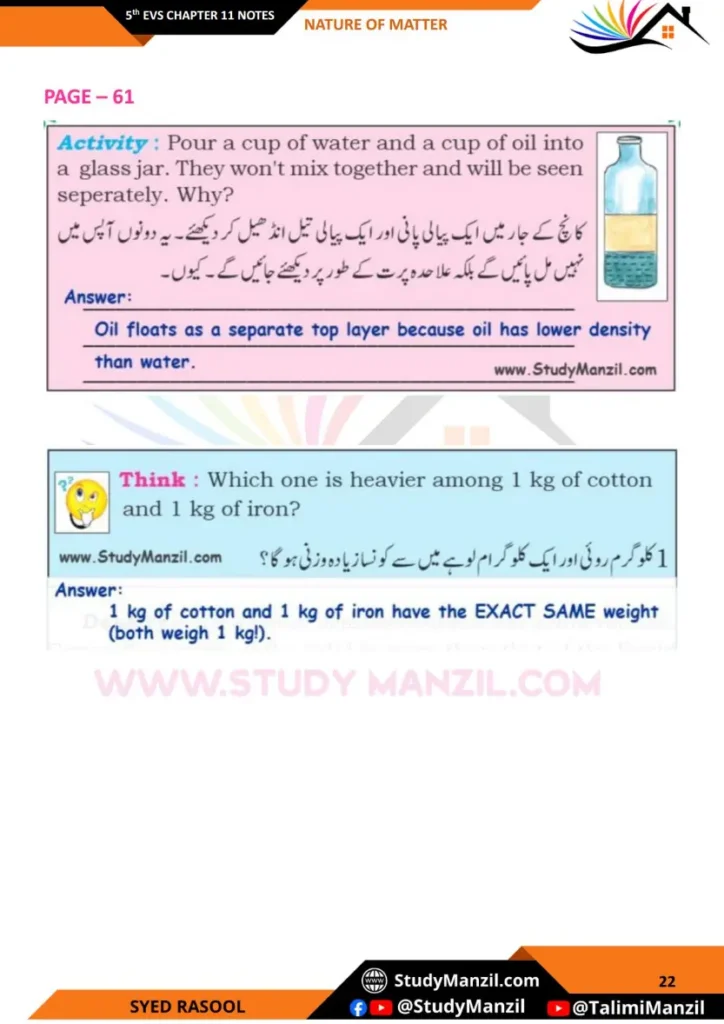
Density: The amount of mass contained in a unit volume ( ). Solids generally have higher density than liquids, and liquids higher than gases.
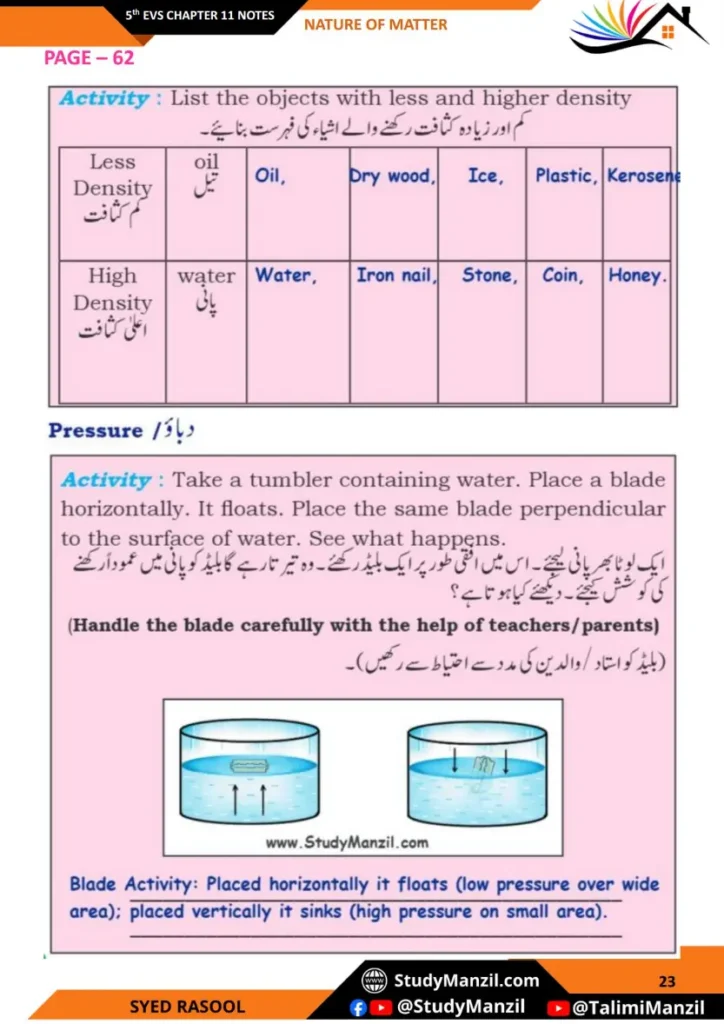
Pressure: The force exerted on a unit area ( ). A wider surface area results in less pressure (floating), while a smaller surface area results in higher pressure (sinking).
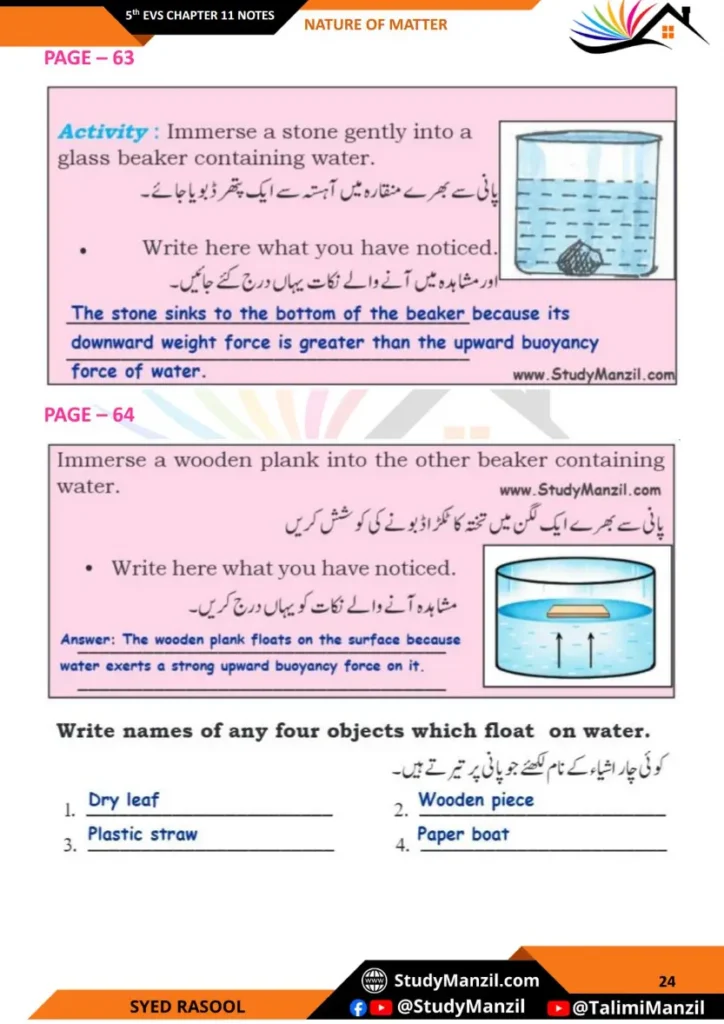
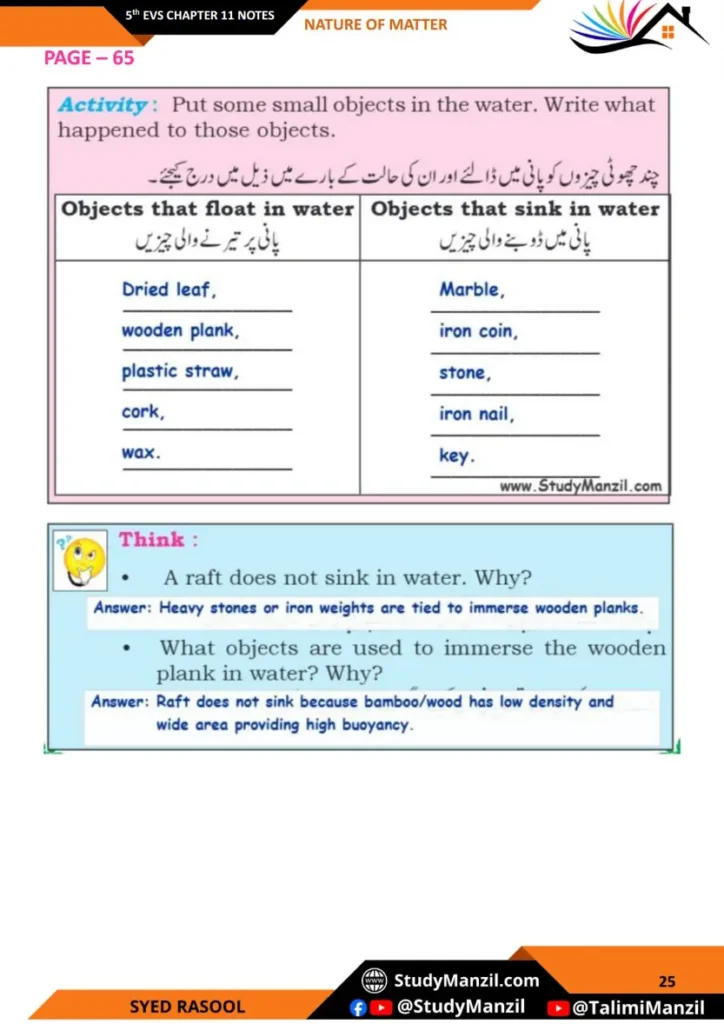
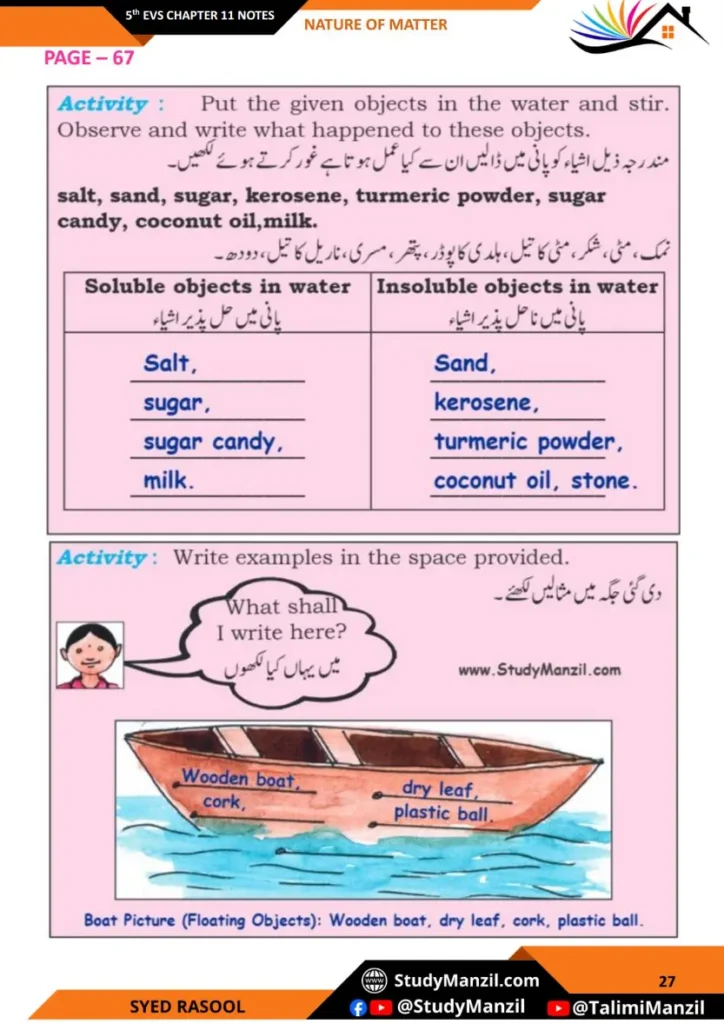
Buoyancy: The upward force exerted by water on an object immersed in it. If the upward force (buoyancy) is greater than the downward force (weight), the object floats.
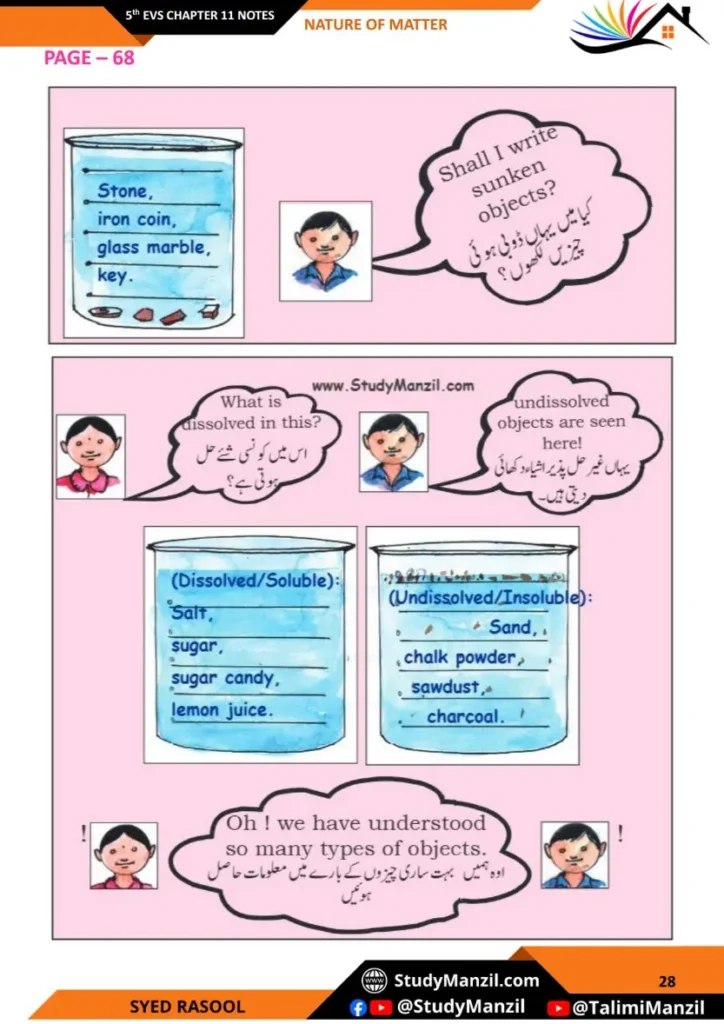
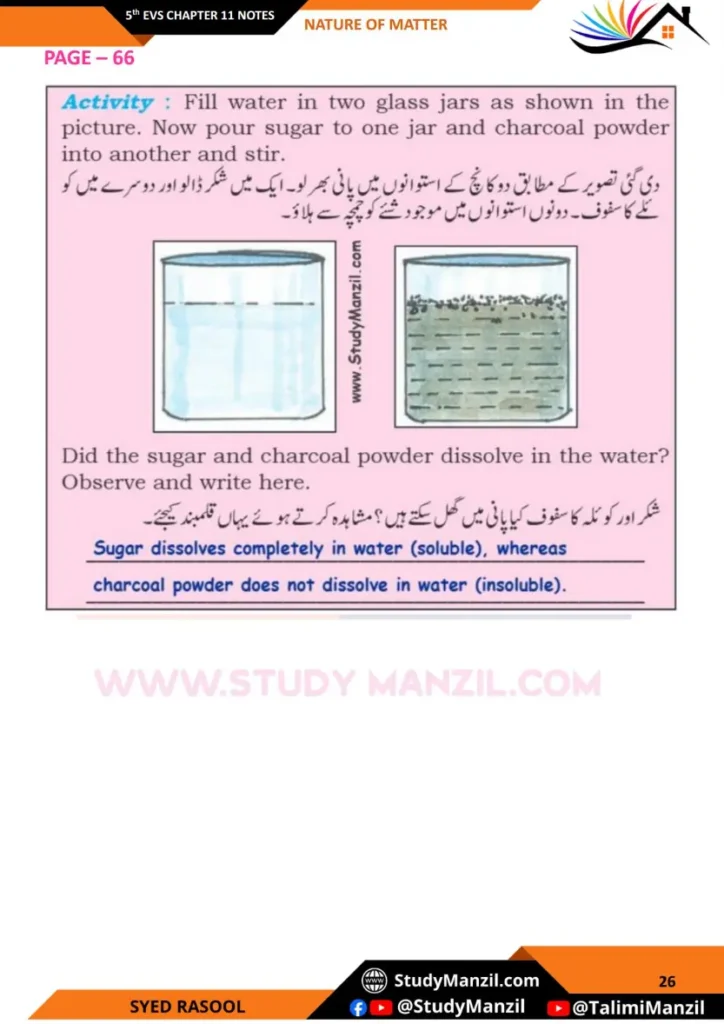
Solubility: The ability of a substance to dissolve in water (soluble vs. insoluble substances, e.g., sugar dissolves, while sand or charcoal powder does not).
Part 2: Page-by-Page Textbook Solutions
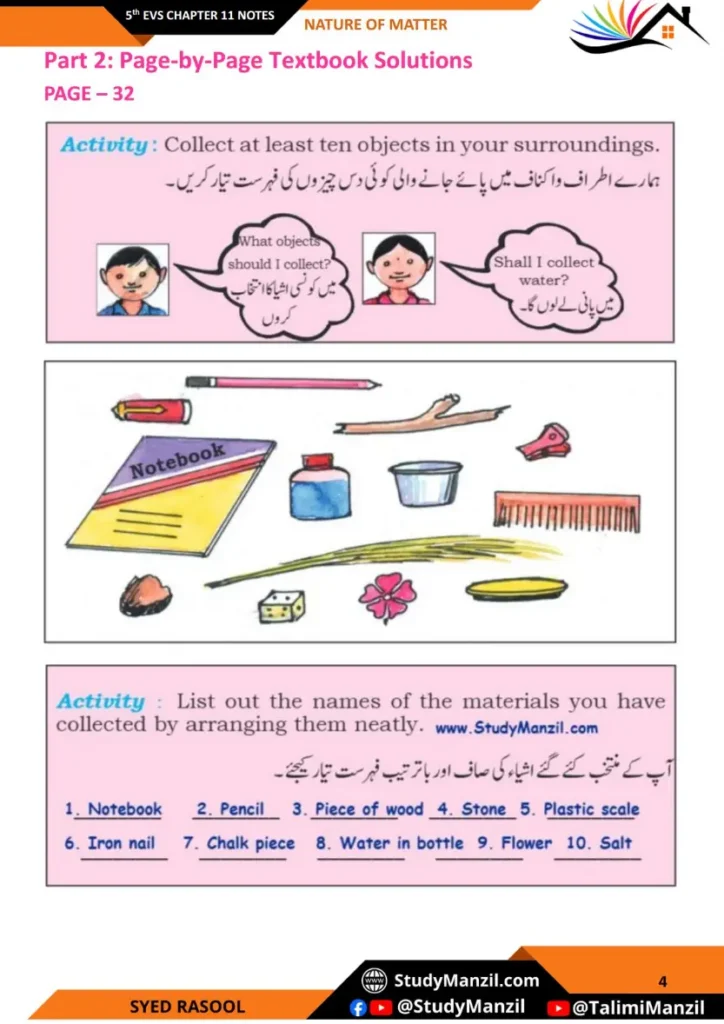
PAGE – 32
PAGE – 33-35
Bilingual Class 5 EVS Chapter 9 Notes Food – Essence of Life | KSEEB Solutions | www.notes.studymanzil.com
PAGE – 36-37
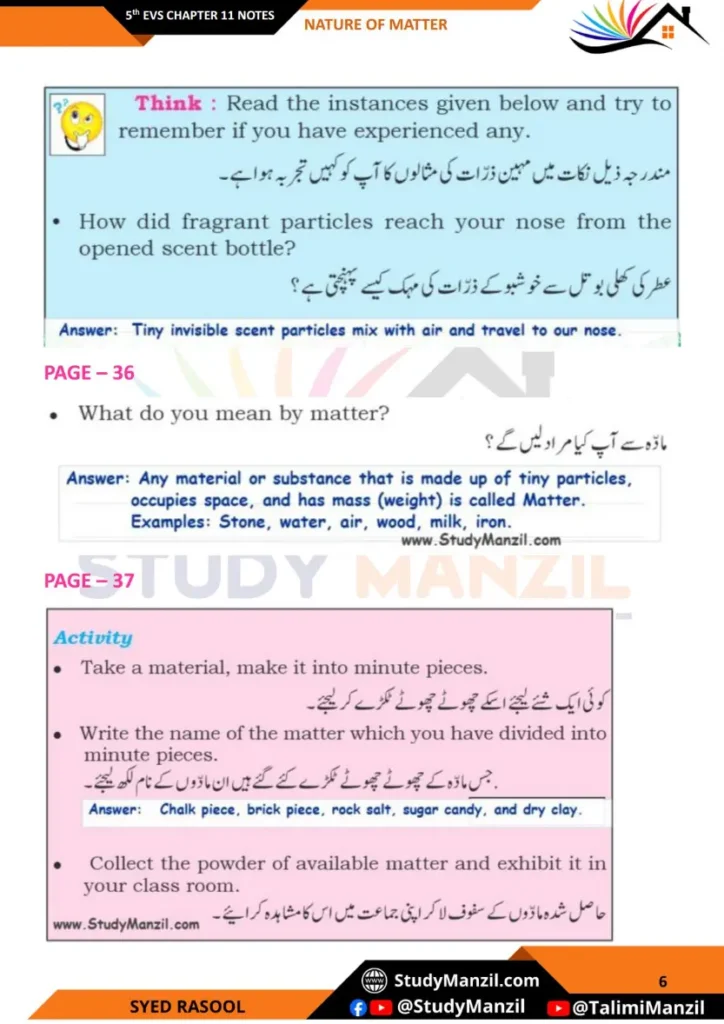
PAGE – 38
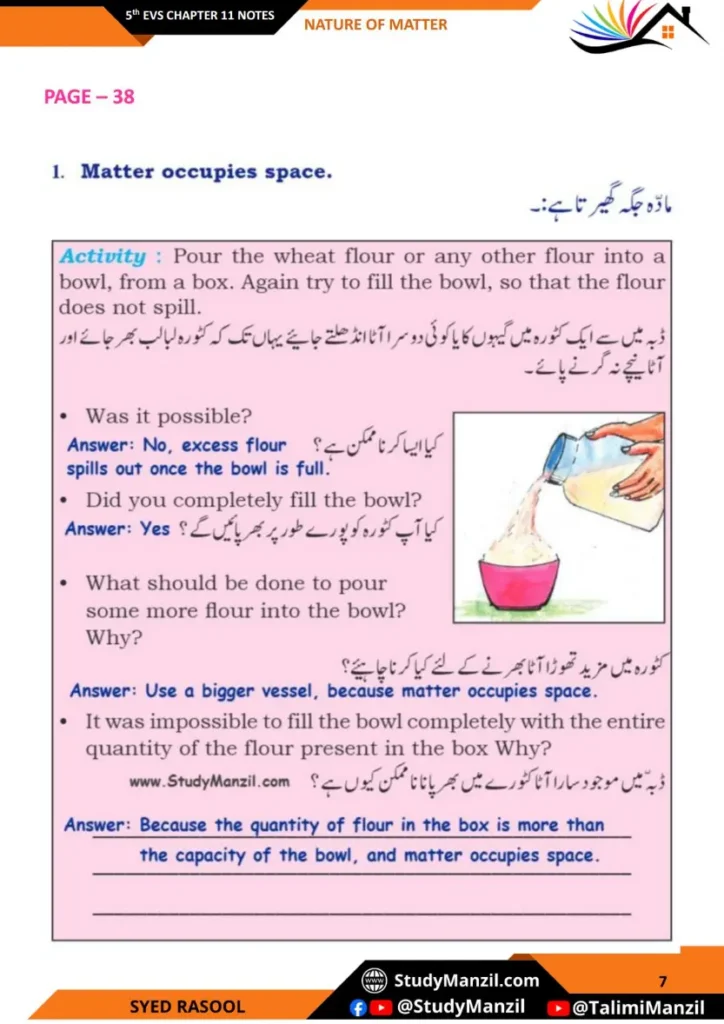
PAGE – 7 & 8
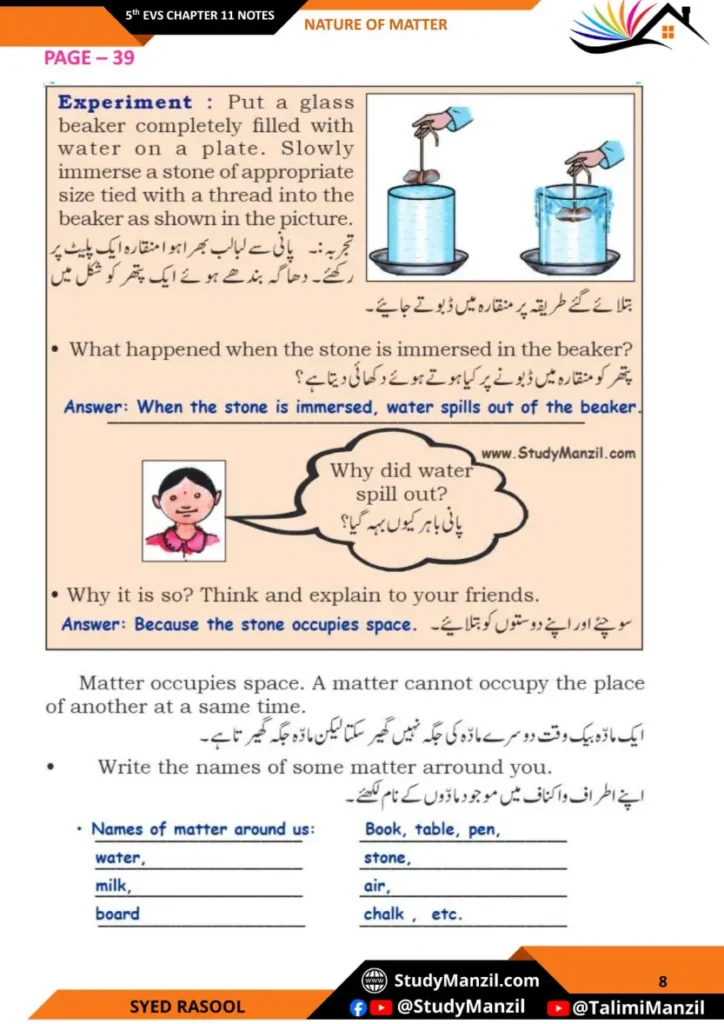
PAGE – 40-41
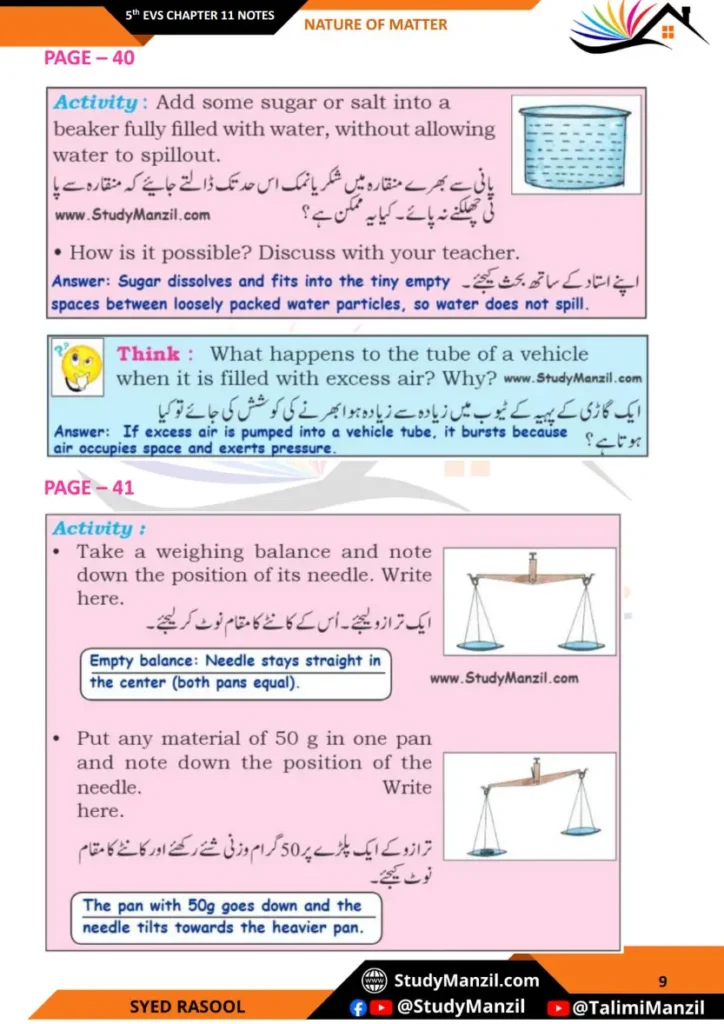
PAGE – 42
PAGE – 43
PAGE – 44 & 45
PAGE – 46
PAGE – 48
PAGE – 51
PAGE – 52
PAGE – 53
PAGE – 54-55
PAGE – 56-60
PAGE – 61
PAGE – 62
PAGE – 63
PAGE – 65
PAGE – 66
PAGE – 67
PAGE – 68